
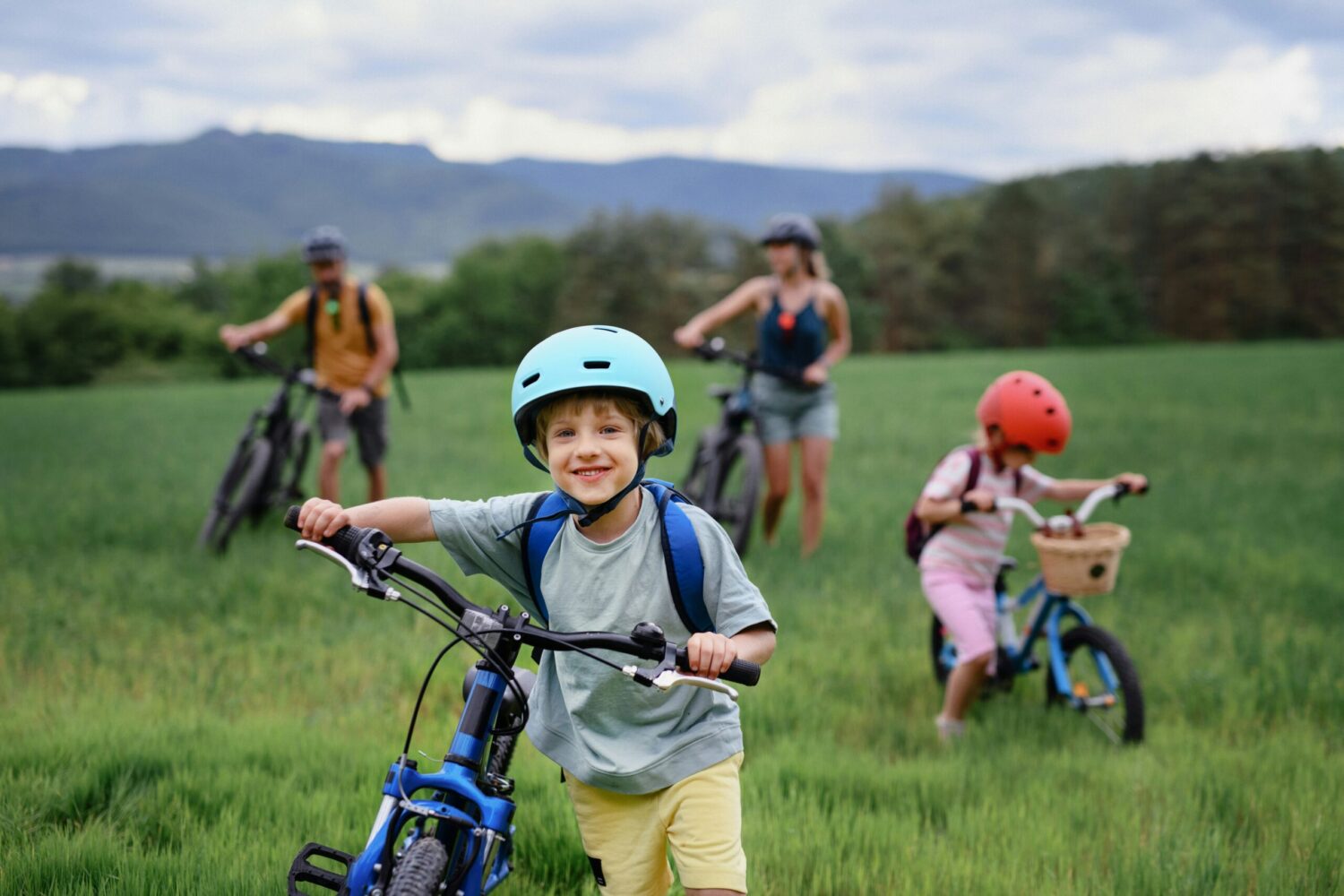
Bicycles give children independence, exercise, and the simple pleasure of going somewhere under their own power. They also move fast enough for small mistakes to matter. The good news is that the most important safety habits take about a minute to check.
1. Helmet: low, level, and snug
A helmet tipped back like a bonnet leaves the forehead exposed. According to the National Highway Traffic Safety Administration, the helmet should sit level and low—about one or two finger-widths above the eyebrows.
- The side straps should form a V just under and slightly in front of each ear.
- The chin strap should be snug, with room for only one or two fingers underneath.
- When your child opens wide in a big yawn, the helmet should pull down slightly on the head.
- The helmet should not rock forward, backward, or side to side.
Buy a helmet that fits now, not one your child can grow into. Look for the CPSC certification label inside. Replace a helmet after a crash because damage is not always visible.
2. Bike: the child should control it—not wrestle it
Sometimes starting with a pedal-free bike is helpful to teach your child balance before graduating to a bike with pedals. A bike that is too large is harder to start, stop, and steer. Make sure your child can comfortably reach the handlebars and brakes. Before each ride, squeeze the brakes, check that the tires feel firm, confirm the wheels are secure, and tuck loose shoelaces or pant legs away from the chain.
3. Visibility: being right is not the same as being seen
Bright clothing helps during the day. In low light, use reflective gear, a white front light, and a red rear light or reflector. Teach children to assume that drivers have not seen them—especially at driveways, parking-lot exits, and intersections.
4. Route: choose the safest path, not merely the shortest
For younger or less experienced riders, begin in a park, bike path, or other low-traffic space. On the roadway, riders should travel in the same direction as traffic and obey signs, signals, and road markings. Sidewalk rules vary by location, and driveways can be particularly hazardous because drivers may not expect a fast-moving bicycle. Children should always walk bikes across crosswalks.
5. Attention: eyes up, ears available
No texting while riding. Avoid headphones or anything that blocks awareness of traffic, people, dogs, opening car doors, potholes, gravel, and other hazards. Carry belongings in a backpack or secure them to the bike so both hands remain available.
Parents are the most convincing safety equipment
Children notice what adults actually do. Wear your own helmet, stop at intersections, and put the phone away. A rule followed by the entire family feels normal; a rule reserved for children feels negotiable.
The family check is simple: helmet, bike, visibility, route, attention. Sixty seconds at the beginning of a ride can prevent the kind of day no family wants to remember. This information was reviewed, edited and approved by our Medical Director, Timothy D. Watson, MD, FAAP on 9/7/2026.
Sources
NHTSA, Bicycle Safety: https://www.nhtsa.gov/road-safety/bicycle-safety
NHTSA, Fitting Your Bike Helmet: https://www.nhtsa.gov/sites/nhtsa.gov/files/8019_fitting-a-helmet.pdf
Leave feedback about this
You must be logged in to post a comment.